Category Archives: Health

Sugar Tax Hitting the Wrong Spot

Caramel Coffee by Razman CalimanWe’ve all read about the sugar tax being applied to fizzy drinks, which is all well and good. However the tax is bollocks, if they were applying the sugar tax and using the money generated to offset healthier options that would be fine.

Instead the sugar tax just vanishes into the government coffers and is probably spent on more champagne at the government party conference instead.

Action on Sugar

Action on Sugar is a campaign group with the goal of reducing the countries sugar intake, they have a fair bit of pull with both producers and government bodies. They surveyed the most sugar filled drinks, and posted the results here… (and images below).

Are Coca Cola or Fanta the big bad sugar demons or were the sugar highs found elsewhere ?

I wasn’t quite expecting the result to be as it is. Action on Sugar investigated 131 popular hot drinks, and calculated the sugars contained within each of them according to the venue selling them.

The biggest were 99g, which is 3 times the amount contained in a can of coca cola (33g).

The top 20 drinks, with 45% (9) of them being from Starbucks, 40% (8) from Costa Coffee, 10% (2) from KFC and 5% (1) from Cafe Nero, only 1 of them had less than 50g of sugar, and that is only 0.7g less at 49.3g.

Sugar Tax Exempt

There are two bands of tax based on the total sugar contained in the drinks. Medium Sugar at 5 grams and over per 100 millilitres, and High Sugar at over 8 grams per 100 millilitres. The actual rate of taxation is expected to be between 18-24 pence per litre, up to about 50p per standard 2 litre bottle.

The problem is, these hot drinks won’t be subject to the sugar tax, they are exempt.

The biggest were the “Hot Mulled Fruit Venti” from Starbucks, which contains 14.5 grams per 100 millilitres, which is nearly 50% more than Coca Cola at 10g per 100ml, and nearly double the upper sugar tax limit. Yet still Starbucks and Costa Coffee remain exempt from the sugar tax.

A Better Idea

Lazytown

Lazytown – Magnus Scheving

One of my friends says we need to stop tampering with foods so much and return them back to a more natural state.

Magnus Scheving the man behind Lazy Town who is 52 years old, kind of agrees. He uses the example along the lines of you take a fish from the sea and eat it raw its 100% good, steam the fish its 80% good, batter it in breadcrumbs and fry it its 40% good, process the left overs, mash it up, and reform it into fish cakes, roll it in breadcrumbs, deep fry it, and its practically worthless.

The more you process something from its original state the less it becomes worth nutritionally speaking. Given the dude is over 50 and looking damned good, dude may just have a point.

I’m not entirely sure this is what my friend meant, since they were talking about processing foods breaking down natural properties then having to replace said properties and augment tastes with additives but the message is similar. I think my friends idea is an almost an impossible thing to change quickly.

Healthier Options WILL be Taxed

Surely it would be a better idea, if the Tax were calculated, and the supermarkets applied the discount to alternatives. So Diet Coke would be 50p cheaper per bottle and so on. Make it cheaper to eat and drink healthy options. Instead what is likely to happen instead is everything will just increase.

Full Sugar Coca Cola will go up, 50 pence per bottle and SHOCK HORROR, Diet Coke will also increase by the same amount to maintain parity.

How will sugar tax actually help anyone other than making people poorer by taking more tax… perhaps in another 10 yrs, we’ll say we need more tax on sugar drinks and we can increase diets drink another 50p along with healthier drinks?

Below is the results of the investigation by Action on Sugar.
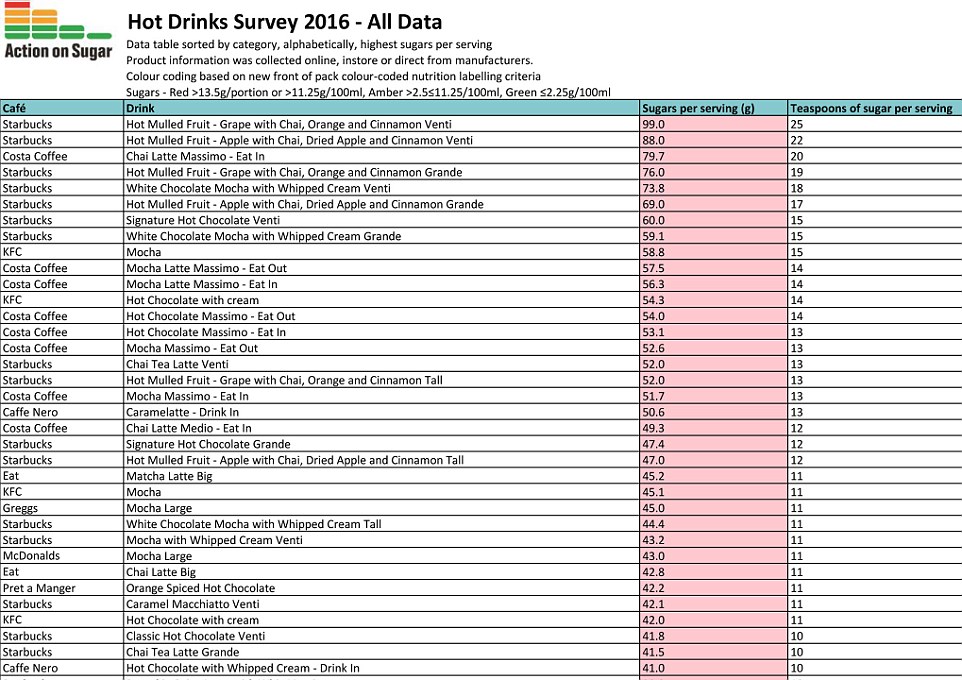
Action on Sugar High Sugar Hot Drinks

Action on Sugar High Sugar Hot Drinks

Action on Sugar High Sugar Hot Drinks

Action on Sugar High Sugar Hot Drinks

Action on Sugar High Sugar Hot Drinks

Action on Sugar High Sugar Hot Drinks

Caramel Coffee image by Razman Caliman, Sugar Charts by Action on Sugar, Lazytown Wallpaper Copyright LazyTown.

Steak vs Lentils for Protein

Summer lunch with spring vegetables, cherry tomato & steak, macro closeup

Steak *drools*

I’ve been reading Muscle and Fitness Magazine and it had a page about Top 10 Protein Facts. What caught my eye were Fact No. 10, which suggested swapping 170g of Steak for 200g of Lentils.

First up they claimed that 170g of steak contained 48g protein, 18g fat (7g sat fat). I’m not sure what sort of beef steak they are eating but 170g steak usually contains nothing like that unless its 13% fat beef burger meat.

Looking at WeightLossResources, it reports the following for 170g of various cuts of Beefs…

Rump Steak – 213 kCal, 37.4g Protein, 0g Carbs, 7g Fat.
Sirloin Steak – 230 kCal, 40g Protein, 0g Carbs, 7.7g Fat.
Stewing Steak – 207 kCal, 38.4g Protein, 0g Carbs, 6g Fat.
Fillet Steak – 255 kCal, 36g Protein, 0g Carbs, 12.5g Fat.

I’m not quite sure where Muscle and Fitness got its stats. They suggest replacing the 170g burger, I mean steak with 200g Lentils, so lets look at 200g Lentils nutritional data.

Lentils (boiled) – 230 kCal, 18g Protein, 40g Carbs (8g Fibre), 1g Fat.

Calories are equal, but half the protein and a boatload of carbohydrates. I noticed they didn’t mention the carb content in the tip either. I’m not adverse to Lentils but I do watch my carb intake, at least try to and even the 8g of fibre can’t justify this one for me.  I’ll stick to a green beans or fine beans

Green/Fine Beans (steamed) – 61 kCal, 3.5g Protein, 14g Carbs (7g Fibre), 0g Fat.

Covers my fibre hit, fits well with my steak and tasty to boot.

Image by Robert Owen-Wahl

Worlds Strongest Man 2016

Brian Shaw WSM Trophy Courtesy of WSM.

Brian Shaw WSM Trophy Courtesy of WSM.

I have been a fan of Worlds Strongest Man for years, and its one of the things which actually got me into gym were WSM. I discovered that guys with my build and strength levels had a sport. I didn’t need a six-pack and bulging muscles, I didn’t need to run a 100 in 10 or anything like that.

Brian Shaw took 1st place with 53pts, followed closely by Hafthor Bjornsson in 2nd just 2pt behind with 51pts who also broke a record or two along the way with Eddie Hall in 3rd with 43pts.

This gives Shaw is 4th WSM Title, matching him with Zyndrunas Savackas, Magnus Ver Magnusson and Jon Pall Sigmarsson. This also takes him ahead of Bill Kazmaier as the most wins for an american. One more win and he’s tying with Mariusz “The Dominator” Pudzianowski with a record 5 wins. Brians ultimate dream will be 2 more wins and he breaks history for 6 titles.

Hafthor Bjornsson broke the keg toss by launching a 15kg keg over 7 meters, he’s certainly racking up the record breaks in recent times. One of my favourite stories about Thor is about why they hired him for Game of Thrones. They needed someone who weren’t dwarfed by and able to lift the huge swords in the show. Most other actors were barely able to even lift the swords but what they didn’t expect is Hafthor to wield the sword with a single hand as if it were made of plastic. They agreed they had found the new Mountain there and then.


Eddie Hall takes his first ever podium spot. Theres lots of opinions such as Hall only got his podium place because Zyndrunas were out of contention this year due to a back injury. In saying that, Hall has been destroying deadlift records as the first man ever to break the 500kg barrier which many thought were another year away at least. Some speculate his concentration on deadlift has slowed his progress down speed and endurance wise.

Konstantine Janashia from Georgia

Konstantine Janashia from Georgia via FB.

Konstantine Janashia from Georgia placed in somewhat of a shocker, first time in Worlds Strongest Man and he placed 4th place.

He’s quoted as saying early in 2015 “If I continue to grow at the same rate, in three years I will definitely be among the top five of the strongest men in the world.“.

Looks like he’s fulfilled his prophecy, in the various events he placed above Brian Shaw, Hafthor Bjornsson and Eddie Hall. After Day 1 of the WSM Final, he were in second place behind Shaw with Bjornsson in 3rd and Hall in 4th Place. Even if Savickas were in contention the Georgian Giant as they call him, would have been top 5 anyway.

At 24 years old, and 160kg I think we will be seeing a whole lot more of Janashia in future worlds contests and he’s certainly on track for a podium placement.

Looking at the previous placements over the last 8 yrs

Year First Second Third
2016 Brian Shaw
(USA)
Hafthor Bjornsson
(Iceland)
Eddie Hall
(UK)
2015 Brian Shaw
(USA)
Zydrunas Savickas
(Lithuania)
Hafthor Bjornsson
(Iceland)
2014 Zydrunas Savickas
(Lithuania)
Hafthor Bjornsson
(Iceland)
Brian Shaw
(USA)
2013 Brian Shaw
(USA)
Zydrunas Savickas
(Lithuania)
Hafthor Bjornsson
(Iceland)
2012 Zydrunas Savickas
(Lithuania)
Vytautas Lalas
(Lithuania)
Hafthor Bjornsson
(Iceland)
2011 Brian Shaw
(USA)
Zydrunas Savickas (Lithuania) Terry Hollands
(UK)
2010 Zydrunas Savickas (Lithuania) Brian Shaw
(USA)
Mikhail Koklyaev
(Russia)
2009 Zydrunas Savickas (Lithuania) Mariusz Pudzianowski (Poland) Brian Shaw
(USA)

The same 3 giants of the WSM game have dominated the podium for the last 8 yrs, the occasional other contender taking a single spot but then falls out of the top 3. However prior to Savickas, Bjornsson and Shaw it were dominated by Pudzianowski and Savickas with lots of random contenders, a much more open podium with 16 different men placing, which is more than double than the last 8.

With Savickas Injured, and Hafthor, Shaw, Hall and Konstantine all in their 20s, there is room for a new face or two on the podium.

Main Photo Copyright of TheWorldsStrongestMan, and Konstantine Photo Copyright of Konstantine Janashia

Moderate Alcohol Isn’t Good For You

Cold Beer by Eyup SalmanThere have long been studies which demonstrate moderate alcohol consumption is good for you, but no longer. The “journal of alcohol and drug studies” performed a systematic meta review, which shows this isn’t the case at all.

A Systematic study is a study of many other peoples studies to correlate the results to get a fuller picture, and a Meta study is where the data from others studies are re-analysed or bias are removed. This means instead of having data on 100 people in one study, they can have results from 100 studies with 100 people each giving them thousands of peoples data across many years.

In this case the review were of 87 studies, covering 3,998,626 people and included 367,103 deaths were recorded over many years.

The Shocker

Previous studies show reduced risk for low volume regular drinkers (1-2 drinks per day), but the study showed many of the abstainers were already of ill health or abstaining due to ill health at the time of the study. This made the regular drinkers appear to have an advantage over the non-drinkers, due to fatalities.

The bias of ill-health were removed from the 4 million subjects and re-analysed, this time is showed that occasional drinkers (1-2 drinks per week) gained an advantage and increased longevity over both non-drinkers, regular drinkers and heavy drinkers.

Its a little shocking that “occasional drinkers” were shown to healthier than non-drinkers and the moderate drinkers we all thought were the better choices.

I would have liked to see if the type of alcohol mattered, since its shown red wine and certain other drinks have some advantages in other studies (at the moment anyway) so does a weekly red wine do more or less than a weekly beer. Saying that, I would want that data analyzed even more to see if wealth were a factor. If the red wine drinkers were healthier, were they generally more affluent.

Image Courtesy of Eyup Salman.

MyFitnessPal Maybe Listens

A while ago I posted a few shortfalls of myfitnesspal, and I also wrote to MyFitnessPal with the issues. The main issues were, the way it tracked water. Where you had to physically go to the drop down menu every day and choose “add water” then scroll down to actually add water.

MyFitnessPal Water

MyFitnessPal Water

To make the water show you had to bring up the menu to the right with “Add Water”, “Add Note” etc, which would make the water counter and the “+ Add Water” appear.

The other issue I pointed out were the tracking of Sodium and Salt. The app fails to differentiate between Sodium and Salt. It may also be that the people entering the data didn’t calculate the difference. This means a packet of Biltong which has 2g of Salt is assumed to be 2,000mg of Sodium, where it is actually 800mg Sodium. This means you are always going over your suggested Sodium limit, when in reality you simply aren’t.

You can mitigate this by altering your goal to a maximum 5,500mg, on assumption its ALL salt, which is about 2,300mg sodium. I have set mine to 4,000mg which allows most of the sodium to be incorrectly assumed as salt and some to the correctly identified as sodium. If you are aiming for low sodium, I would probably leave it at the default 2,300mg and accept it as being sodium.

I however noticed about a week to 10 days ago, the “+ Add Water” and Tracker has been permanently enabled making it easier to add and track water… sadly the salt/sodium issue still exists.

There is however some hope, and I’ll message them again in a month or so.

As a side note, if you want to convert Salt -> Sodium or Sodium -> Salt, an easy method is Sodium -> Salt just Divide by 2.5 or Salt -> Sodium multiply by 2.5.

Here is a quick chart with some useful conversions and information on it.

Salt Sodium Equivelent Advice
1g 400mg A pinch of salt.
1.25g 500mg Quarter of a Teaspoon. Heart, Lung & Blood Ass. Min. Amount.
1.5g 600mg A big pinch of salt.
2g 800mg Low Sodium Diet Suggestion.
3g 1,200mg Half Teaspoon.. Diabetic Max. Suggestion.
4.25g 1,800mg 1/4 Tablespoon.
5g 2,000mg Recommended Target Zone.
6g 2,400mg 1 Teaspoon. Max Recommended Amount.
8.5g 3,600mg 1/2 Tablespoon. UK Average Comsumption.
9g 3,800mg US Average Comsumption
12g 4,800mg 2 Teaspoons.
17g 6,800mg 1 Tablespoon.

Its common sense but still worth mentioning, when a recipe calls for a “Teaspoon” of salt, if it makes 6 portions, you need to think each one will contain only 1g salt / 400mg sodium not 6g.

Its also worth mentioning when you have sweated a lot, like after a good hours work out, you may need a little sodium on those days, but you should research the appropriate amounts yourself.

I’m going to message MFP again and push the Sodium issue. I suspect its going to be a huge task, since their whole database will need differentiating. I have been there before, the longer you leave it, the bigger and the harder the task becomes.

** 3,200 kcal is an increase for heavy training days not my general count.

High Energy, High Protein, Body Transformation

There were an article in the American Journal of Clinical Nutrition earlier this year, about body composition. The team of scientists at McMaster University in Canada proved that a low calorie, high intensity weight training with added HIIT (High Intensity Interval Training) combined with high protein can cause dramatic and substantial changed in body composition in as little as 28 days.

Rough Shape

Taking 40 men in “rough shape”, hey there words not mine, cutting their usual calorie intake by 40% (this were calculated by body weight not the standard 2000/2500) and making them undertake intense exercise. I love this quote by Stuart Phillips who is the lead quack “It was a gruelling affair, These guys were in rough shape, but that was part of the plan. We wanted to see how quickly we could get them into shape: lose some fat, but still retain their muscle and improve their strength and fitness.”. Nowt like being told your rough as…

The Split

They split the guys into 2 groups, both groups were on the reduced calorie diet but the protein intakes were different as follows.

Group 1: High Protein, were taking 2.4 grams of protein per kilogram of body weight.
Group 2: Low Protein, were taking 1.2 grams of protein per kilogram of body weight.

Both groups were prescribed the same program of high intensity weight training AND interval training (cardio), 6 days per week, so quite intensive.

Group 1: High Protein lost 11 lbs of fat, gained 2.5 lbs lean muscle mass.
Group 2: Low Protein lost 8 lbs of fat, gained only 0.2 lbs (thats 3 oz) of lean muscle mass.

What’s interesting is that with such a huge deficit in calories none of the guys lost any muscle mass. I sort of expected them to lose more fat with the body struggling to maintain its muscle mass. Phillips went on to say “Exercise, Particular listing weights, provides a signal for muscle to be retained even when your in a big calorie deficit”. This kind of supports my view that you’d burn more fat to retain it.

The Twist

Again Phillips appears to have thought the same as I did that the higher protein group wouldn’t burn as much far, but in reality they lost 33% more fat. He said “(we) were a little surprised by the amount of additional fat loss in the higher protein consuming group.”.

There is an interesting caveat, Phillips says “We designed this program for overweight young men, although I’m sure it would work for young women too, to get fitter, stronger, and to lose weight fast. It’s a tough program and not something that’s sustainable or for those looking for quick and easy fix,”, he goes on to say “We controlled their diets, we supervised the exercise, and we really kept these guys under our ‘scientific’ thumb for the four weeks the participants were in the study.”.

The precise details of the diet, exercise and such aren’t released but the blueprint is there so should be reproducable to a good extent. There is a ray of hope, the same team hope to do a follow up study where its not so strict and potentially sustainable.

Myth Busters

This study maybe the tip of the iceberg which busts the myth that you can’t cut and bulk at the time time. It appears you can but its going to test your mettle, and push you to the edge.